Wednesday, April 8, 2009
Kuda Lumping

These small replicas of the larger kuda lumping that are used in a trance dance on Java are cut out from woven bamboo mats and painted with striking colored patterns. Sequins, beads and other materials can also be added to give the kuda lumping its colorful appearance.
When given to a child, their imaginative minds are the only limit as to what dramas these kuda lumping are the center of! Although intended as a toy, many of these delightful horses end up in suitcases to be given as souvenirs of an expat's trip to Indonesia.
Mobil-mobilan Kulit Jeruk

Although today's children may think that cars made from Jeruk Bali skins are no match for contemporary toy cars, many Indonesian men have fond memories of these home-made cars. Jeruk Bali is a large pomelo (grapefruit-like) that has a very thick skin. Once the fruit has been removed, the skin can then be then cut into pieces that will form the parts of the car.
Stiff coconut frond ribs are used to hold the pieces together. A long stick is attached to the back of the car and can be used to push the car along. Sometimes a string is tied to the front of the car so that it can be pulled behind the owner as well. This very simple toy has brought a smile to the faces of many Indonesian children.
sources : expat.or.id , digitalart.org
LAYANG LAYANG (KITE FLYING)
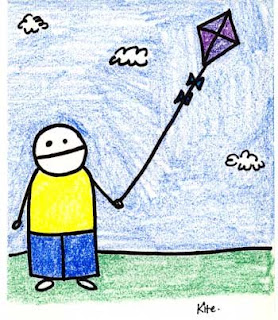
Layang-layang or kite flying is a very popular pastime for Indonesian children. Provinces throughout the country have their own designs. There are two distinct types of kites: the first is those that are just to be used for flying which have a tailed attached to them to balance the kite; and those that will be used for one-on-one dogfights, a favorite pastime amongst kite flyers.
Fighting kites do not have tails attached to them. They are made from light bamboo and waxed paper. Often the string that is attached to these kites is coated with crushed glass. The string is dipped in a solution of crushed glass, which has been boiled with ka, chemicals and dye. The mixture acts as an adherent so the tiny particles of glass will cling to the string. The string is strung out on a small rack to let it dry. This process makes the string very sharp and capable of cutting the opponents string.
Fighting kites do not have tails attached to them. They are made from light bamboo and waxed paper. Often the string that is attached to these kites is coated with crushed glass. The string is dipped in a solution of crushed glass, which has been boiled with ka, chemicals and dye. The mixture acts as an adherent so the tiny particles of glass will cling to the string. The string is strung out on a small rack to let it dry. This process makes the string very sharp and capable of cutting the opponents string.
Ready-made glass coated string can also be bought in various thickness. . Most kite flyers opt to buy ready-made string as it is a long and messy process to prepare their own. The choice of the thickness of the string would depend the on the size of the kite, and a greater consideration, the budget of the buyer. If the owner is not careful this string can also cut his fingers as well!
The object of the game is to try and cut the opponents' kite loose. The way that the string is attached to the kite determines the control that the flyer has over his kite. If the two holding strings are attached far apart to the frame of the kite, this will make it heavier to hold on to when it is flying. However, this gives the kite flyer greater control over the movements of the kite.
BEKEL
I like it... I like to play this game
not long ago , I used to play it with my students. But now I don't (-.-)
Well, let's find out, what Bekel is.
This is the equivalent of western jacks, and is commonly played by Indonesian girls. The shape of the bekel differs from the western jacks in that they are flat with a small bridge holding the two sides together. On the upper side of the biji bekel there is a small red dot that is called the pit. The under side of the bekel is called a roh. On one of the flat sides of the biji bekel there are small indentations or dots and the other side is smooth.
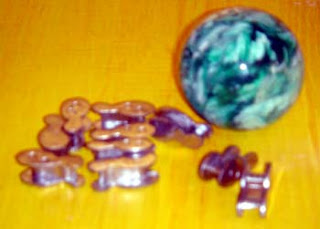
The game is played is a similar method to jacks, but with a few differences. When the game is started, the biji bekel are all held in the hand of the player and are dropped as the ball is allowed to bounce one time. The player then starts to play by attempting to pick up the biji bekel one at a time without disturbing any of the other biji bekel within the time that it takes the ball to bounce once.
If the player successfully has picked up all of the bekel, he then drops them again and starts the second set of the game. In this set he must attempt to position the biji bekel with the pit facing up again one at a time. This action must be completed while the player throws the ball in the air and allows it to bounce one time. The player must attempt to turn over the bekel without moving any of the other bekel.
If the player completes this successfully, he then picks up the biji bekel one at a time while throwing the ball in the air until he has all of the biji bekel in his hand. He then drops them all again and now picks the biji bekel up two at a time and then three at a time, etc. until he picks up all the biji bekel with one sweep of the hand.
He drops them again and now starts the roh set. The player must attempt to turn over all the biji bekel so the roh side is now facing up. It is permitted to pick up more than one group of the set number while the ball is being thrown in the air. For example if the player is picking up groups of two while the ball is being thrown in the air, he may grab three groups of two bekel. The action of grabbing a set number of bekel is called cek.
If the player moves any of the biji bekel that he is not attempting to pick up, or if he drops any of the biji bekel in his hand, he loses his turn and it goes to the next player. A skilled player can go through many sets of the game before he makes a mistake and has to turn the bekel over to the next player. The player that completes the most sets without making a mistake is considered the winner of the game.
The name is derived from the Dutch game"bikkelen" using the same copper "bikkels".
ah, talking bout this game. remembering minie's childhood.
sources : expat.or.id, anakreatif.com
;;
Subscribe to:
Posts (Atom)





,+Jakarta.jpg)